
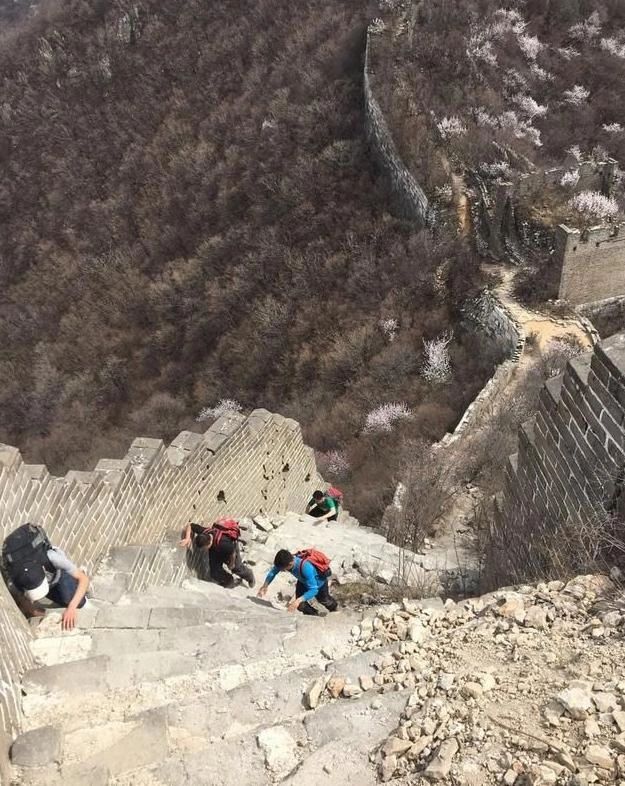
The Jiankou Great Wall is located in the territory of Huairou, west of the Mutianyu Great Wall and east of Xiangshui Lake Scenic Area. The whole journey is about 15 kilometers. The Great Wall trend completely twists and turns along the mountain, and is roughly "W" shaped; The arrow was named the Great Wall of Arrows. The Jiankou Great Wall is also famous in the country for its serpentine trends, great fluctuations, the broken walls of the old disrepair, and its amazing, dangerous, strange, special and original ancient Great Wall landscape. Every year, hikers from all over the country come to Jiankou to see its magnificence.
Jiankou Great Wall
Hikers use the name Jiankou for a wider Great Wall area rather than one fixed start and finish. Its eastern routes connect toward Mutianyu, while the western routes extend toward Xiangshui Lake. Eastern landmarks include Mutianyu, Ox Horn Edge, Zhengbeilou Tower, and Little Potala Palace. To the west are the Sky Ladder, Eagle Flies Facing Upward, Beijing Knot, and Jiuyanlou. The western routes are more severely weathered and can involve collapsed masonry, very steep climbing, and passages requiring technical experience. Ordinary sightseeing visits are better matched to Mutianyu, while selected eastern Jiankou routes suit experienced hikers with appropriate guiding.
Niujiaobian is a sharply turning section near the junction of Jiankou and Mutianyu. The Wall climbs, drops, and bends back across the mountainside in a shape associated with an ox’s horn. Centuries of weathering have left the masonry rugged, with high points above 940 meters.
Zhengbeilou Tower stands near Xizazi Village on eastern Jiankou, also known locally as Zhenbeilou. This Ming-era tower served defensive and storage functions. It measures approximately 11.9 meters from east to west, 9.52 meters from north to south, and 10.8 meters high. Thirteen courses of stone support its brick upper structure, with a corridor-style interior. Much of the upper parapet has collapsed. Four defensive openings face east and west, with five to the north and south. Its elevated position makes it a well-known viewpoint on the Jiankou route.
The tower known as Little Potala Palace stands on a high point of eastern Jiankou. Its elevated position and distinctive profile explain the comparison with Tibet’s palace. Hikers often pause here for lunch or a rest during the route.
Sky Ladder: The western line of Jiankou is similar to a section of the Great Wall that climbs vertically. It rises nearly 100 meters vertically. The steps are narrow and small. Basically, it can be said that only one person can pass. Because of the years of disrepair, some steps have been damaged, revealing the gravel inside; it is an extremely dangerous place. But recently, repairs have begun here, and the damaged steps and guards have been re-corrected. Although the safety has been increased, the original characteristics of the arrow buckle have been lost.
At the entrance to Kengcun, opposing rock formations resemble a general guarding a gateway. Each is about 20 meters high and five meters wide. The formation is associated with the village’s traditional scenic landmarks and appears in local descriptions of its landscape.
Ying Fei Yin Yang: Ying Fei Yin Yang is 115 meters long. It is located in Xi’an Village, Xizhazi Village, Yanqi Town. Starting from the southeast corner of the Xiaohuoshan Mountain, the mountain steeply and steeply descends. A peak of about 800 meters suddenly rises abruptly. Dangerous and anomalous, the side wall rises vertically on the cliff. It is rumored that the goshawk flew up here and flew on its back, so it was called "Eagle Flying Down".
Beijing Knot, also known as the Great Wall Knot or Sanchakou, marks a junction of the inner and outer Great Wall lines near Zhuanghu Village in Huairou. The junction stands at about 958 meters above sea level. Its rectangular defensive platform measures approximately 10.1 meters long, 9.9 meters wide, and 7.1 meters high, with a stone base and brick upper structure. The branching defenses connect the mountain routes in different directions.